

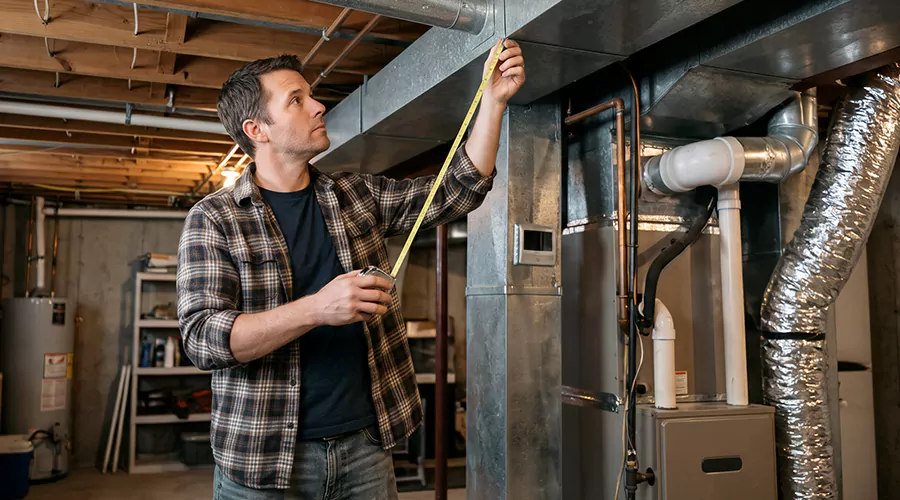
Your air ducts may be undersized if several rooms receive weak airflow, supply or return vents make excessive noise, the HVAC system operates against unusually high static pressure, or certain rooms remain uncomfortable despite normal equipment operation. However, these symptoms do not prove that the ducts are too small. Dirty filters, crushed flexible ducts, closed dampers, and air leaks can create similar problems. A professional air duct cleaning service can inspect ductwork for dust buildup and obstructions that may restrict airflow before further repairs are considered.
HVAC ducts are designed to move specific amounts of heated or cooled air between the central equipment and the rooms it serves. If the passages are too small, they may create excessive resistance and prevent the system from delivering the required airflow.
Undersized ductwork can affect comfort, drying of cooling coils, blower performance, and equipment operation.
Identifying the problem accurately requires more than comparing duct diameters. A qualified HVAC contractor should evaluate room heating and cooling loads, measured airflow, duct resistance, and the equipment manufacturer's requirements.
What Does Undersized Ductwork Mean?
Undersized ductwork is a distribution system that cannot move the required volume of air under the available pressure conditions. The problem may involve a main supply trunk, individual branch duct, return duct, or several connected sections.
The U.S. Department of Energy explains that undersized ducts create high pressure losses, resulting in reduced airflow and increased fan energy use. Duct sizing depends on the equipment's airflow needs, duct length, fittings, construction material, and room requirements. A duct that appears small is not necessarily undersized, and a larger duct is not automatically appropriate.
What Are the Warning Signs of Undersized Air Ducts?
| Warning Sign | Possible Explanation |
|---|---|
| Weak airflow at several vents | Supply network may be too restrictive |
| Loud return grille | Return opening or duct may be too small |
| Whistling registers | Excessive velocity through narrow openings |
| Uneven room temperatures | Branches may not deliver required airflow |
| High static pressure | Excessive resistance in the system |
| Duct popping or banging | Pressure-related metal panel movement |
| Repeated cooling problems | Airflow may be below equipment requirements |
| Blower noise | Fan may be working against high resistance |
| Persistent discomfort after filter changes | A deeper duct or design issue may exist |
These signs justify investigation, but none establishes undersized ducts without further testing.
1. Several Rooms Have Weak Airflow
Low supply airflow across multiple rooms may indicate that the main trunk cannot carry the necessary air volume. If only one room has weak airflow, the problem may involve that room's branch duct instead. Check the air filter, supply registers, and return openings before assuming a sizing problem. A technician can measure delivered airflow at individual registers and compare it with the design requirements.
2. The HVAC Vents Make Excessive Noise
Air moving through restrictive ducts or grilles can create whistling, roaring, or rushing sounds. The DOE identifies excessive pressure and airflow velocity as potential consequences of improperly sized duct systems.
A loud return grille may indicate insufficient return capacity, while noisy supply registers may involve restrictive branches or outlet sizing. However, air leaks and partially closed louvers can produce similar sounds. The source should be identified before changing duct dimensions.
3. The System Has High Static Pressure
Static pressure describes the resistance that the HVAC blower must overcome to move air. Undersized ducts can increase this resistance. A technician measures total external static pressure with suitable instruments and compares it with the manufacturer's specifications.
High pressure may also result from a dirty filter, restrictive cooling coil, or closed damper. Pressure readings should be evaluated across individual components to determine where the restriction occurs. There is no single acceptable pressure value for every residential HVAC system.
4. Some Rooms Never Reach the Desired Temperature
Persistent temperature differences can indicate that certain rooms do not receive enough conditioned air. An upstairs bedroom may remain hot while nearby rooms reach the thermostat setting. However, inadequate insulation, direct sunlight, and excessive air leakage can increase a room's cooling load.
ACCA Manual J is used to calculate room heating and cooling requirements. ACCA Manual D then provides methods for designing ducts to deliver the required airflow. Both the building load and duct system should be evaluated.
5. The Return Air Duct Is Too Small
Return ducts bring indoor air back to the furnace or air handler. An undersized return can restrict airflow throughout the HVAC system, even when supply ducts are reasonably sized.
Possible signs include a loud central return grille, high return-side pressure loss, and weak overall airflow. Some homes also lack suitable return pathways from bedrooms when doors are closed. A contractor may recommend enlarging a return, correcting a restrictive grille, or installing an appropriately designed additional return pathway.
6. Your Ducts Pop or Bang During Operation
Large sheet metal duct panels can flex under changing pressure. The DOE's residential duct retrofit guidance identifies undersized ducts as a possible cause of popping or banging, sometimes called oil canning. These noises may occur when the blower starts or stops.
However, thermal expansion, loose supports, and contact with framing can also cause duct noise. Pressure testing and inspection are more reliable than diagnosing duct size from sound alone.
7. HVAC Equipment Was Replaced Without Evaluating the Ducts
A replacement HVAC system may have different airflow requirements from the equipment previously installed. If a larger-capacity unit is connected to existing undersized ducts, airflow problems may become more noticeable. Even replacing equipment with the same nominal capacity does not automatically confirm that the original duct system was correctly designed.
ACCA Manual S addresses equipment selection, while Manual D covers duct design. Contractors should verify equipment requirements and duct capacity during significant system changes.
How to Check if Your Air Ducts Are Undersized?
Step 1. Identify the Affected Areas
Record which rooms have weak airflow or persistent temperature problems. Note whether the symptoms occur during heating, cooling, or both.
Step 2. Open Supply and Return Vents
Check for closed louvers, furniture, rugs, and other obstructions. Do not restrict additional vents to force air toward the affected rooms.
Step 3. Inspect the HVAC Filter
Replace a dirty filter with a compatible product. A restricted filter can create symptoms similar to undersized ductwork.
Step 4. Examine Accessible Ducts
Look for crushed flexible branches, excessive bends, loose connections, and damaged supports. The DOE warns that flexible duct compression can significantly increase resistance. Correcting installation defects may improve airflow without increasing duct dimensions.
Step 5. Measure System Airflow
An HVAC technician can measure airflow through the equipment using appropriate diagnostic methods. The result should be compared with the equipment manufacturer's operating requirements.
Step 6. Measure Static Pressure
The contractor can check pressure differences across the supply network, return network, filter, and other relevant components. This helps identify where excessive resistance is occurring.
Step 7. Measure Individual Room Airflow
A suitable airflow capture hood can measure supply delivery in cubic feet per minute, abbreviated CFM. The technician compares each room's measured airflow with its required delivery.
Step 8. Perform Duct Sizing Calculations
The contractor should use recognized duct design methods, such as ACCA Manual D. Calculations consider friction losses, equivalent fitting lengths, available pressure, and required airflow.
Step 9. Correct the Identified Restrictions
The solution may involve larger duct sections, improved returns, repaired flexible ducts, or better fittings. Some systems need balancing rather than complete duct replacement.
Step 10. Verify the Results
After repairs, recheck static pressure and delivered airflow. Testing confirms whether the revised system meets the equipment and room requirements.
Can Undersized Ducts Damage an HVAC System?
Severe airflow restrictions can affect equipment operation.
An air conditioner with insufficient airflow may experience evaporator coil freezing or other cooling problems. Professional air duct installation can help provide properly sized and routed ductwork to support adequate airflow and reliable cooling throughout the building.
A furnace may experience high-temperature limit trips when airflow is inadequate. Variable-speed blowers may also consume more energy under certain restrictive conditions as they attempt to maintain airflow. These effects depend on the equipment and severity of the restriction. Proper measurements are needed before identifying duct sizing as the cause.
Can Air Duct Cleaning Fix Undersized Ductwork?
No. Air duct cleaning cannot increase the diameter of an undersized passage. Cleaning may help when significant debris is physically blocking a duct, but ordinary dust deposits are not the same as a design restriction.
Damaged or undersized ducts require appropriate repair, rerouting, or replacement. Do not pay for repeated cleaning when the underlying issue is inadequate duct capacity.
Should You Replace All Your Air Ducts?
Not necessarily. A contractor may identify one restrictive return, several undersized branches, or a poorly designed main trunk. Targeted modifications may correct the problem without replacing the entire network.
However, widespread design defects or severely damaged ductwork may justify substantial replacement. A professional assessment should explain which sections are inadequate and why.
Conclusion
Undersized air ducts can cause weak airflow, excessive vent noise, high static pressure, and uneven room comfort. These symptoms can also result from dirty filters, damaged ducts, or poor balancing, so diagnosis should involve actual measurements. A qualified HVAC contractor can compare equipment airflow requirements with room loads and perform ACCA Manual D duct calculations. The appropriate repair may involve enlarging selected passages, improving returns, or correcting restrictive duct installations.